How the new cancer plan can improve outcomes for patients with ovarian cancer in England

Introduction
Across the UK there are 41,000 women living with ovarian cancer and over 6,000 women each year in England are diagnosed with the condition.3 4 Over 4,000 women lose their lives each year.5
Ovarian cancer is the sixth most common cause of cancer related death in the UK amongst women.6 There are a number of different types of ovarian cancer depending on the type of cell they originate from.7
Ovarian cancer is often diagnosed at an advanced stage due to limited awareness of symptoms and a lack of effective early screening methods. The main symptoms of ovarian cancer are:
• Persistent bloating
• Feeling full quickly and/or loss of appetite
• Pelvic or abdominal pain
• Urinary symptoms (needing to wee more urgently or more often than usual)
Other symptoms include changes in bowel habit, extreme fatigue and unexplained weight loss.8
Late-stage detection leads to later treatment and poorer survival rates than many other cancers. The UK has recorded some of the poorest ovarian cancer outcomes in Europe.9 NHS data show that the estimated five year survival rate from ovarian cancer in England is 45%. This is the sixth poorest outcome out of 25 cancers measured. It is less than half the rate of cancer of the testis and melanoma that have the highest estimated five year survival rates.10
However if diagnosed early, 9 in 10 women diagnosed with ovarian cancer will survive.11
Conclusion and summary of recommendations
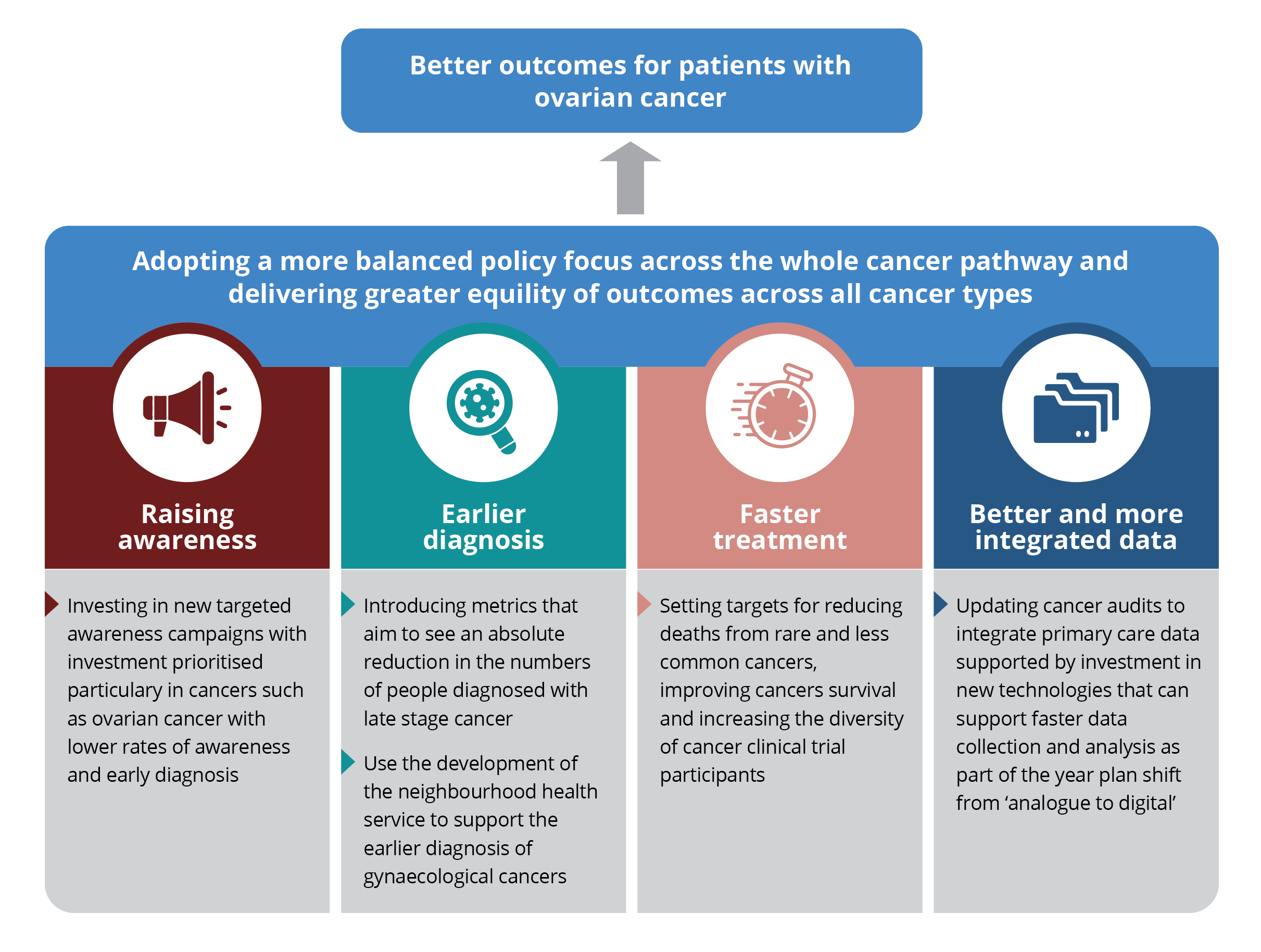
The forthcoming cancer plan as well as the three shifts in the ten year NHS plan present opportunities to make new progress in raising awareness, increasing earlier diagnosis rates and improving access to treatment for patients with ovarian cancer.
To do this the plan will need to focus on delivering greater equity of outcomes between rare and less common cancers, such as ovarian cancer and more common cancer types. The following recommendations should help support this:
- Adopting a more balanced policy focus in the new cancer plan across the whole cancer pathway
- Investing in new targeted awareness campaigns with investment prioritised particularly in cancers such as ovarian cancer with lower rates of awareness and early diagnosis
- Introducing metrics that aim to see an absolute reduction in the numbers of people diagnosed with late stage cancer
- The development of a neighbourhood health service as part of the ten year NHS plan should support the expansion of women’s health hubs and set out how it will support the earlier diagnosis of gynaecological cancers
- Setting targets for reducing deaths from rare and less common cancers, improving survival and increasing the diversity of cancer clinical trial participants
- Updating cancer audits to integrate primary care data supported by investment in new technologies that can support faster data collection and analysis as part of the ten year NHS plan shift from ‘analogue’ to digital’
3 https://targetovariancancer.org.uk/about-us/media-centre/key-facts-and-figures
4 https://targetovariancancer.org.uk/sites/default/files/2025-06/National%20Cancer%20Plan%20final%20
submission%202025.pdf
5 https://targetovariancancer.org.uk/about-us/media-centre/key-facts-and-figures
6 https://pmc.ncbi.nlm.nih.gov/articles/PMC9472236/
7 https://targetovariancancer.org.uk/about-ovarian-cancer/what-ovarian-cancer/types-ovarian-cancer
8 https://www.cancerresearchuk.org/about-cancer/ovariancancer/symptoms
9 https://www.thelancet.com/journals/lanonc/article/PIIS1470-2045(13)70546-1/abstract
11 https://targetovariancancer.org.uk/about-us/media-centre/key-facts-and-figures
This independent report was commissioned and funded by AbbVie. Full editorial control rests with Future Health.