Better together:
How Government and business can partner to improve the health of the UK workforce

Executive summary
Over 2.7 million people are economically inactive due to poor health. And increasing numbers of people in work are also struggling with their mental and physical health, with the highest rises being seen in younger people.1 Worklimiting conditions contribute to a ‘health pay gap’ reducing earnings by 15% and contribute to wider inequalities in society.2 Lost productivity resulting from illhealth is estimated to cost the UK economy £150 billion per year or 7% of GDP.3
If the UK Government is to deliver on its central economic mission and wider health ambitions, then improving health at work needs to be a strategic priority. There is good evidence from other countries that access to occupational health and employee health schemes can help reduce levels of economic inactivity.4
Businesses are also taking a greater interest in how to improve the health and wellbeing of their staff. New polling from Savanta of 1000 businesses has found that 1 in 4 are thinking of introducing or expanding private medical insurance (PMI) and/or employee assistance programmes (EAPs). Over half of employers are concerned about long NHS waiting times and 3 in 10 have seen an increase in staff sickness rates in the last year (compared to 10% who have seen a decrease).5
The previous administration had begun to explore policies and measures to improve the health of the workforce and reduce rates of economic inactivity. This included consultations on how to expand occupational health provision and whether tax incentives for businesses should be used to support investment in schemes that improve employee health.6 7
The Government is clear that it wants a new partnership with business to deliver economic growth.8 However the announced rise in employer national insurance at the 2024 Autumn Budget will curtail business investment which could well impact workplace health schemes.9 Whilst a series of pilots and programmes have been announced to tackle economic inactivity, most are not focused directly on supporting employers to help keep their staff well and in work. The 2024 Autumn Budget saw no action taken on health related tax incentives which could have sent an important signal to businesses of Government wanting to build an important partnership on workplace health.10
The next Government fiscal statement should urgently address this and seek to build a partnership with businesses to break down the barriers they face to improving workforce health – particularly amongst small and medium-sized organisations. Measures to do so should include introducing a minimum legal standard of occupational health provision and an expansion in the necessary workforce to deliver it; all underpinned by clear guidance and evidence on what works supported by fiscal and tax incentives to drive uptake. The reforms in the new ten year NHS plan should also be used to deliver health improvements in the UK workforce and productivity.
Adopting such measures would be good for UK health, UK plc and the UK Government.
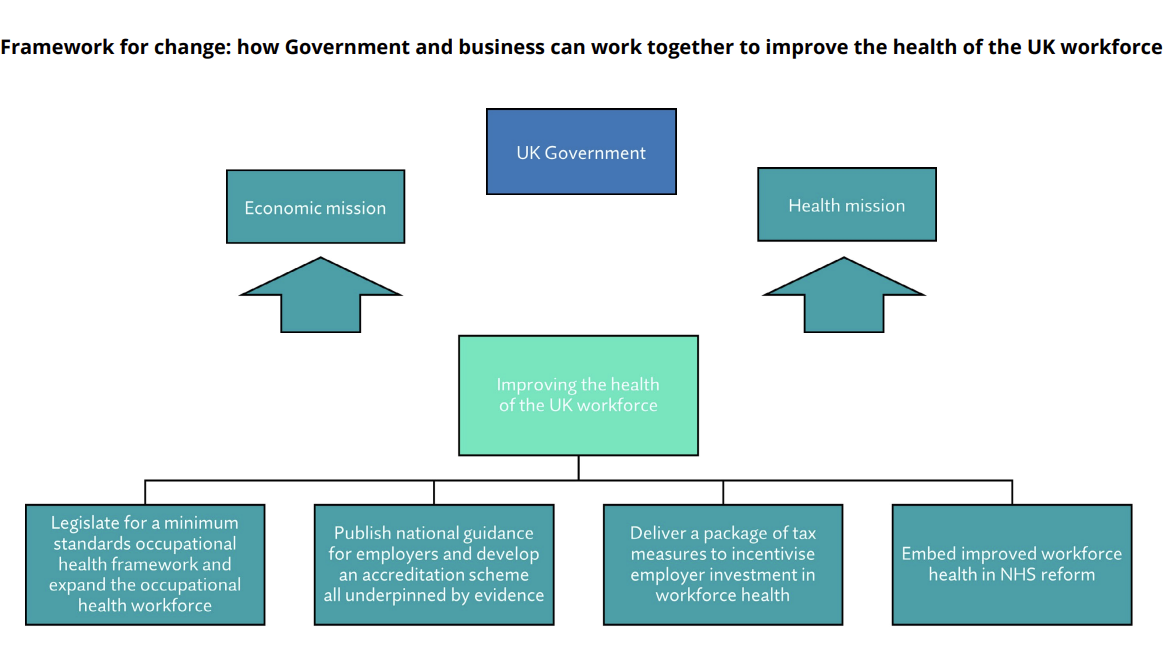
Summary recommendations
1. Legislate for a minimum standards occupational health framework and expand the workforce
2. Publish national guidance for employers and develop an accreditation scheme all underpinned by evidence
3. Deliver a package of tax incentives that enable a step change in workforce health coverage
4. Embed improved workforce health within health service reforms
5 Savanta polling of 1000 businesses conducted in October 2024; commissioned by IHPN
6 https://www.gov.uk/government/consultations/occupational-health-working-better
This report is sponsored by the Independent Healthcare Providers Network (IHPN) and has been authored by Future Health. The views and conclusions in the report remain those of Future Health and should be attributed as such. Future Health takes full responsibility for the content of the report and associated publications.