Delivering interconnected
cardiovascular-renal-metabolic care:
A draft policy roadmap for improving the screening and earlier diagnosis of patients with Chronic Kidney Disease and liver disease
Introduction
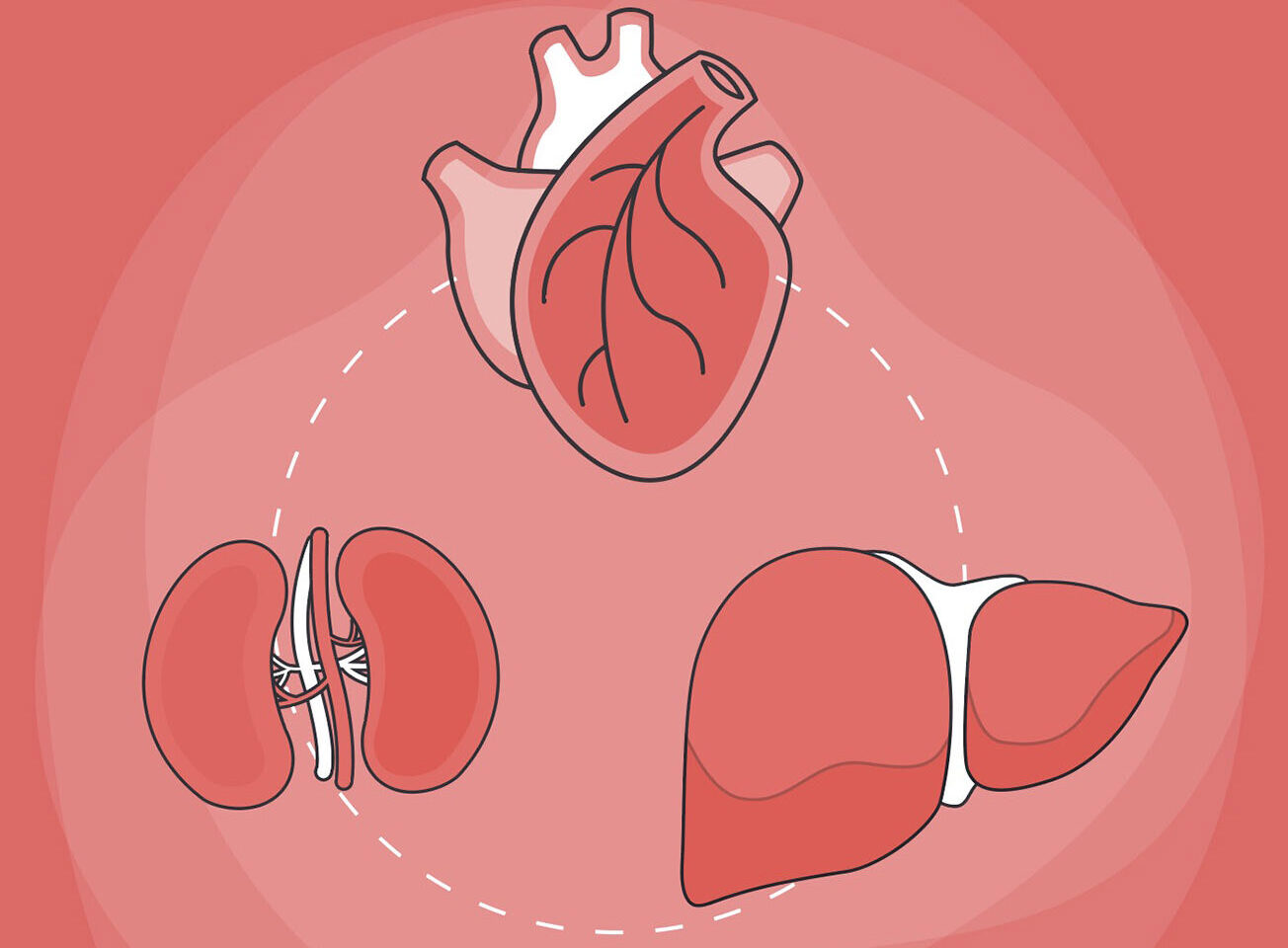
Cardiovascular disease (CVD) is the world’s biggest killer today – with nearly twenty million people dying from CVD in 2022 – and is set to remain so in 2050.2 As set out in Future Health’s The power of connection report, one of the drivers behind this burden, is the rising numbers affected by interconnected Cardiovascular-Renal-Metabolic (CRM) conditions which include diabetes, Chronic Kidney Disease (CKD), obesity and liver disease.3
The WHO has set a target of reducing premature mortality from NCDs including CVD by a third by 2030 – but most countries remain off track to deliver on these ambitions.4
CRM conditions – CVD, CKD, type 2 diabetes, obesity and liver disease – are biologically and clinically interconnected. They share common underlying causes – particularly excess fat around the organs, the body’s reduced response to insulin – and persistent low-level inflammation, and they tend to cluster in the same patients in ways that amplify risk. Patients with CKD and liver disease are more likely to die from cardiovascular events than kidney or liver failure.5 6
Greater effort is needed to diagnose CRM conditions earlier, so patients can get the care and treatment they need. Two CRM conditions in particular, have very low rates of diagnosis and rising patient, health system and economic costs.
- CKD affects 850 million people globally but fewer than 10% with the condition are aware of it7
- Metabolic Dysfunction-Associated Steatotic Liver Disease (MASLD) affects an estimated 38% of adults globally today and this is expected to rise to 55% by 2040. 20-30% of those with MASLD are expected to progress to Metabolic Dysfunction-Associated Steatohepatitis (MASH).8Studies have shown that a significant majority of those with MASH are undiagnosed9
Diagnosis for both conditions often takes place when irreversible damage has already been done – resulting in higher rates of mortality, impaired quality of life for patients and carers, and healthcare costs many times greater than those associated with earlier-stage disease.10 11 12 13 14
Screening and earlier intervention can empower patients to make lifestyle changes as well as open up opportunities to explore pharmacological treatments which can help slow, halt or even reverse damage to these vital organs.15 16
The positive news is that the earlier diagnosis of both conditions is achievable – the tools exist and are improving, the evidence base supports their use and a growing number of countries have demonstrated that systematic screening in high-risk populations can be delivered at scale.
New international commitments from 2025 including the WHO resolution on ‘Reducing the burden of noncommunicable diseases through promotion of kidney health and strengthening prevention and control of kidney disease’17 and the UN General Assembly political declaration on NCDs and mental health – which for the first time explicitly commits signatories to strengthening screening and management for both CKD and MASLD – create opportunities for action.18
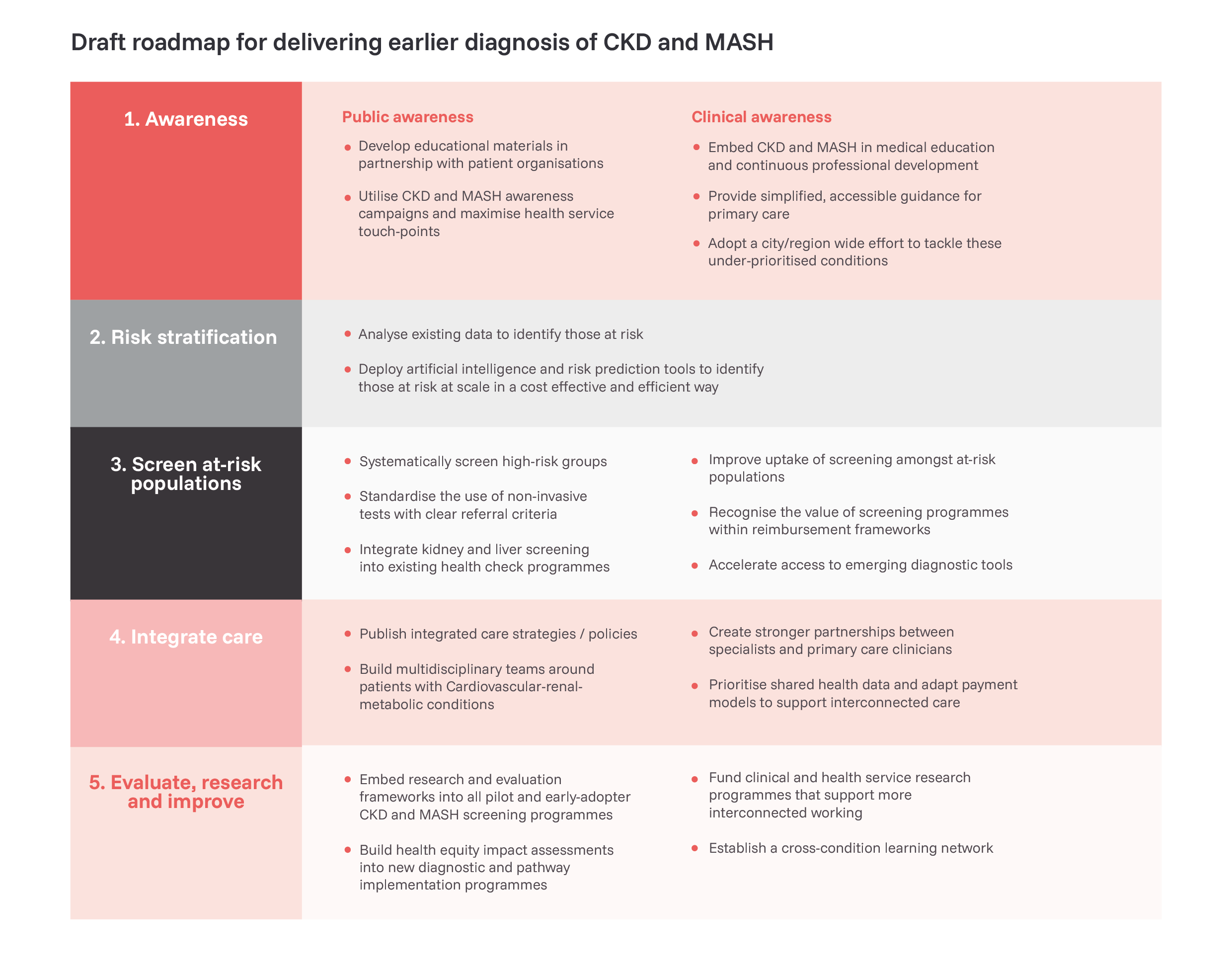
This draft roadmap translates available evidence into a practical framework that policymakers can draw on to design, prioritise and implement earlier diagnosis approaches for CKD and MASH that can deliver more interconnected strategies to tackling CRM conditions helping to reduce mortality rates, system costs and wider economic impacts.
Consultation
This roadmap is a draft and has been developed based on an extensive evidence and literature review, set of expert interviews and feedback from different countries. This roadmap aims to deliver on a number of global health policy goals including:
- Sustainable Development Goal 3.4 — to reduce premature mortality from NCDs102
- WHO 2025 Resolution on ‘Reducing the burden of noncommunicable diseases through promotion of kidney health and strengthening prevention and control of kidney disease’103
- UN Political Declaration on NCDs which includes commitments to CKD and MASLD diagnosis and management104
- WHO 2026 draft Resolution on ‘Steatotic liver disease: a missing piece in the global noncommunicable disease response’105
References
2 Institute for Health Metrics and Evaluation (IHME). Global Burden of Disease 2021: Findings from the GBD 2021 Study. 2024. https://www.healthdata.org/sites/default/files/2024-05/GBD_2021_Booklet_ FINAL_2024.05.16.pdf
3 Future Health Research. The power of connection: Strengthening health policy responses to cardiovascular, renal and metabolic diseases. 2025. https://futurehealth-research.com/report/the-power-of-connection-strengthening-health-policy-responses-to-cardiovascular-renal-and-metabolic-diseases/
4 WHO. SDG Target 3.4 | Noncommunicable diseases and mental health. https://www.who.int/data/gho/data/themes/topics/indicator-groups/indicator-group-details/GHO/sdg-target-3.4-noncommunicable-diseases-and-mental-health
5 Jankowski J et al. Cardiovascular disease in chronic kidney disease: pathophysiological insights and therapeutic options. 2021. https://www.ahajournals.org/doi/10.1161/CIRCULATIONAHA.120.050686
6 Minetti ET et al. Drivers of cardiovascular disease in metabolic dysfunction-associated steatotic liver disease: the threats of oxidative stress. 2024. https://www.frontiersin.org/journals/cardiovascular-medicine/articles/10.3389/fcvm.2024.1469492/full
7 Global Patient Alliance for Kidney Health. An Open Letter to the Delegates
to the 77th World Health Assembly. 2024. https://globalkidneyalliance.org/
wp-content/uploads/2024/05/WHA-open-letter_052724f.pdf
8 Guo Z et al. Global burden of MAFLD, MAFLD related cirrhosis and MASH related liver cancer from 1990 to 2021. 2025. https://www.nature.com/ articles/s41598-025-91312-5
9 Lazarus JV, et al. A call for doubling the diagnostic rate of at-risk metabolic dysfunction-associated steatohepatitis. 2025. https://www.thelancet.com/ journals/lanepe/article/PIIS2666-7762(25)00112-7/fulltext
10 Luthra R et al. Understanding MASH: An Examination of Progression and Clinical Outcomes by Disease Severity in the TARGET-NASH Database. 2024. https://link.springer.com/article/10.1007/s12325-024-03085-4
11 Mody SH. Reducing the Economic and Clinical Burden of CKD in the Managed Care Setting. 2004. https://pmc.ncbi.nlm.nih.gov/articles/ PMC3564292/
12 Kandasamy G et al. Determinants of Health-Related Quality of Life in Patients with Chronic Kidney Disease: A Cross-Sectional Study. 2025. https://www.mdpi.com/2227-9032/13/10/1167
13 Spencer D et al. Health care costs associated with unrecognized progression to late-stage kidney disease. 2023. https://www.ajmc.com/ view/health-care-costs-associated-with-unrecognized-progression-to-late-stage-kidney-disease
14 Fishman JC et al. Cost burden of cirrhosis and liver disease progression in metabolic dysfunction-associated steatohepatitis: A US cohort study. 2024. https://www.jmcp.org/doi/10.18553/jmcp.2024.24069
15 Sloan L. SGLT2 inhibitors across the spectrum of chronic kidney disease: a narrative review. 2024. https://www.tandfonline.com/doi/full/10.1080/00325481.2024.2418795
16 Cusi K et al. Metabolic Dysfunction-Associated Steatotic Liver Disease (MASLD) in People With Diabetes: The Need for Screening and Early Intervention. A Consensus Report of the American Diabetes Association. 2025. https://diabetesjournals.org/care/article/48/7/1057/160536/Metabolic-Dysfunction-Associated-Steatotic-Liver
17 World Health Organisation. Reducing the burden of noncommunicable diseases through promotion of kidney health and strengthening prevention and control of kidney disease. 2025. https://apps.who.int/gb/ebwha/pdf_files/EB156/B156_(20)-en.pdf
18 United Nations. Political Declaration of the Fourth High-Level Meeting of the General Assembly on the Prevention and Control of Noncommunicable Diseases and the Promotion of Mental Health and Well-being. 2025. https://cdn.who.int/media/docs/default-source/ncds/finalized-pd-on-ncds-and-mental-health-rev4-3-september-2025.pdf
102 WHO. SDG Target 3.4 | Noncommunicable diseases and mental health. https://www.who.int/data/gho/data/themes/topics/indicator-groups/indicator-group-details/GHO/sdg-target-3.4-noncommunicable-diseases-and-mental-health
103 WHO. Reducing the burden of noncommunicable diseases through promotion of kidney health and strengthening prevention and control of kidney disease. 2025. https://apps.who.int/gb/ebwha/pdf_files/EB156/B156_(20)-en.pdf
104 United Nations. Political Declaration of the Fourth High-Level Meeting of
the General Assembly on the Prevention and Control of Noncommunicable Diseases and the Promotion of Mental Health and Well-being. 2025. https://cdn.who.int/media/docs/default-source/ncds/finalized-pd-on-ncds-and-mental-health-rev4-3-september-2025.pdf
105 WHO. Steatotic liver disease: a missing piece in the global noncommunicable disease response. 2026. https://apps.who.int/gb/ebwha/pdf_files/EB158/B158_R1-en.pdf
This independent report was commissioned and funded by Boehringer Ingelheim in partnership with Future Health. Boehringer Ingelheim provided guidance throughout the project however full editorial control rests with Future Health.
GB material number: NP-GB-107469. Date of preparation: May 2026.