The ‘economics of health’: Considerations for re-orientating the Department of Health and Social Care towards economic growth

Executive summary
Whether it is six milestones, six steps for changes, five missions, three foundations or the Prime Minister’s two priorities, the focus for this Government is on delivering economic growth.1,2
Traditionally health – and specifically within Government – the Department of Health and Social Care (DHSC), has been on the periphery of discussions and policy decisions relating to the economy.
But with high rates of economic inactivity, rising health and welfare spending and the UK’s sluggish growth, there is an increasing recognition that the Department of Health and Social Care has a more active and important role to play in the wider growth agenda. There are positive opportunities to be seized too, particularly in health innovation and life sciences where backing UK innovators and encouraging international inward investment can deliver growth across the country. The NHS’s role
as an anchor institution can also be used to support regional growth efforts.
The new Secretary of State for Health and Social Care used one of his first speeches in office to set out a ‘economics of health’ framework for how his Department could reorientate itself to support the growth agenda around these themes.
But how realistic is the delivery of such a framework?
This short pamphlet explores this question in two ways. First by examining the forces for and against change in each of the three areas Streeting prioritised in his Tony Blair Institute speech – public health, innovation economy and the NHS as an employer.3 Secondly by looking specifically at the DHSC and how it can be better set-up to support the wider economic growth agenda.
The research finds that there are some strong forces for change at work in each of the three pillars of Streeting’s framework. These include efforts to join-up Government through missions, joint unit endeavours on economic inactivity and life sciences between DHSC, DWP and DSIT respectively, new investment for tackling waiting lists and the conclusion of long running industrial action, along with refreshed life sciences and workforce plans. However there remain strong headwinds to – a focus on child rather than wider population health in public health policy, concerns about the power of the missions to join-up Government, and a mixed track record of delivery from past life science plans and workforce reviews that need to be understood to make any future plans successful.
For the Government and Department the research proposes four changes:
- Ensuring new departmental accountability frameworks into central Government
include metrics pertinent to each part of Streeting’s ‘economics of health’
framework - A different and more elevated economic role for the Department within
Government – particularly in Cabinet Committees and other mission boards - Greater use of economic skills and modelling in the development of health policy
proposals and Ministerial submissions – particularly aligned to the three shifts in
the ten year plan4 - Strengthened Accountability for NHS ICSs in delivering on their economic mandates with regional partners – including Mayors and local authorities on regional growth plans
Streeting’s speech may well have been simply clever political positioning in the run-up to another round of Treasury negotiations in the Autumn 2024 budget. But there are real opportunities to add substance; and with new Government health policy priorities, structures and plans being written, now is the time to seize them.
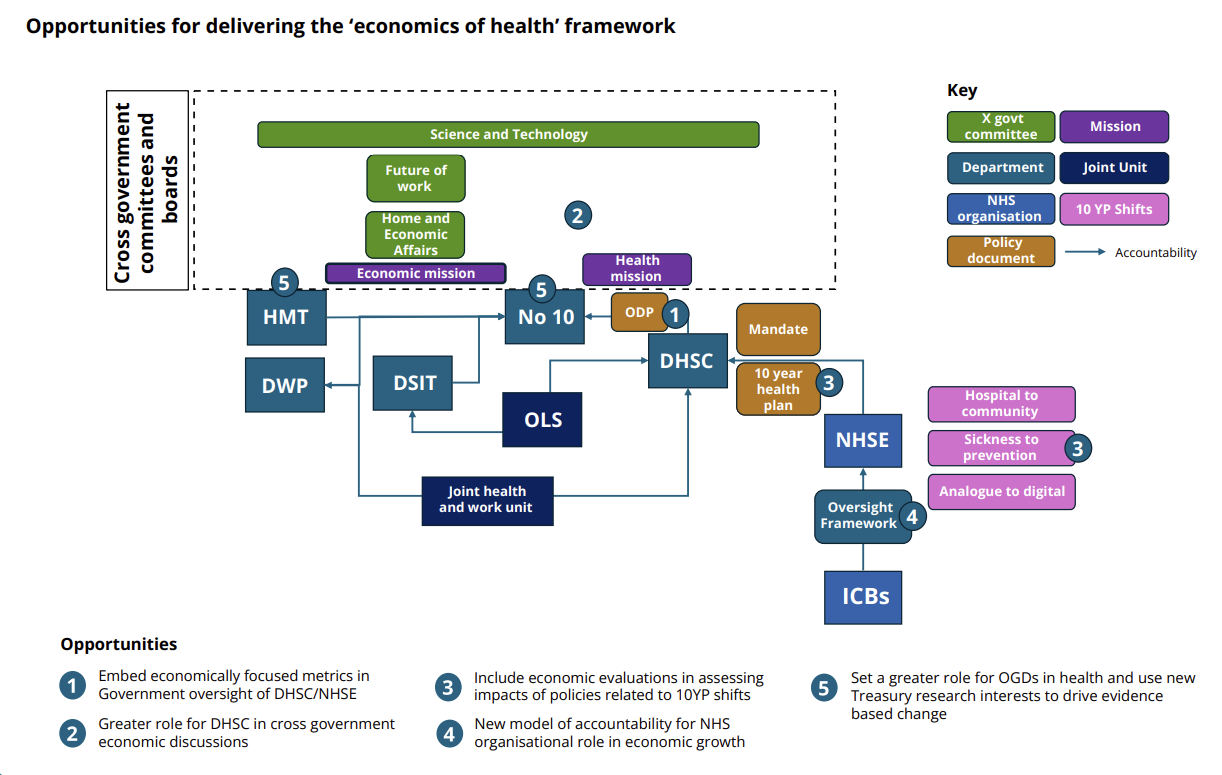
Opportunities for delivering the 'economics of health' framework
- Embed economically focused metrics in Government oversight of DHSC/NHSE
- Greater role for DHSC in cross government economic discussions
- Include economic evaluations in assessing impacts of policies related to 10YP shifts
- New model of accountability for NHS organisational role in economic growth
- Set a greater role for OGDs in health and use new Treasury research interests to drive evidence based change
This independent report was commissioned by Johnson & Johnson UK and authored by Future Health. The views and conclusions in the report are those of Future Health and should be attributed as such. Future Health takes full responsibility for the report and associated publications.