The jewel in the crown?
How a new industrial strategy can deliver for UK life sciences and patients

Executive summary
“The industry is changing, not just year by year but month by month. Now, there is pressure on healthcare budgets in the West and we’ve got our ageing populations. Meanwhile, we’ve got the emerging economies in the East and an explosion of knowledge. Now, I think that all these things together create a new paradigm for life sciences. And in this new paradigm, we must ensure that the UK stays ahead. Because yes, we’ve got a great leading science base. And yes, we’ve got four of the world’s topten universities. And yes, we have a National Health Service unlike any other.
But my argument today is this: these strengths alone are not enough, and that to keep pace with what’s happening we’ve got to change quite radically. We’ve got to change the way we innovate, the way that we collaborate, and the way that we open up the NHS.” (Prime Minister David Cameron, December 2011)1
As he launched the UK’s first ever life sciences strategy in 2011, Prime Minister David Cameron labelled the sector the ‘jewel in the crown’ for the UK.
Nearly 13 years after Cameron’s speech, the UK remains a major player in global life sciences. Successive Governments have sought to champion the sector with Cameron’s strategy revised in 2017 as part of Theresa May’s Industrial Strategy, and then again following the pandemic, under Boris Johnson in 2021.
The new Labour Government has similarly identified the industry as critical to its mission to delivering the fastest growth in the G7, as well as in supporting reforms to the NHS and improvements in patient outcomes. The sector is one of eight prioritised in the Government’s industrial strategy green paper and the Government looks set to launch its own life sciences plan to deliver on its ambitions.2
Competition for life sciences investment globally is increasingly competitive. Whilst the UK had major successes during Covid, more widely our position in attracting commercial clinical trials – whilst now recovering – has fallen back.3 Countries across the developed world are putting life sciences as a strategic investment priority.4 The success of the new plan will be dependent on learning from what has worked effectively and less effectively in the recent past.
This research finds that the past three strategies have been developed and built in very different ways, each having particular strengths and weaknesses as a result. The most recent Life Sciences Vision which Labour is committed to building from – is underpinned by a set of disease based missions, the progress on which has been mixed. More widely, past strategies have suffered from a lack of clear objectives, fragmentation and co-ordination across Government, piecemeal resources and limited clarity over delivery and accountability.
Recommendations
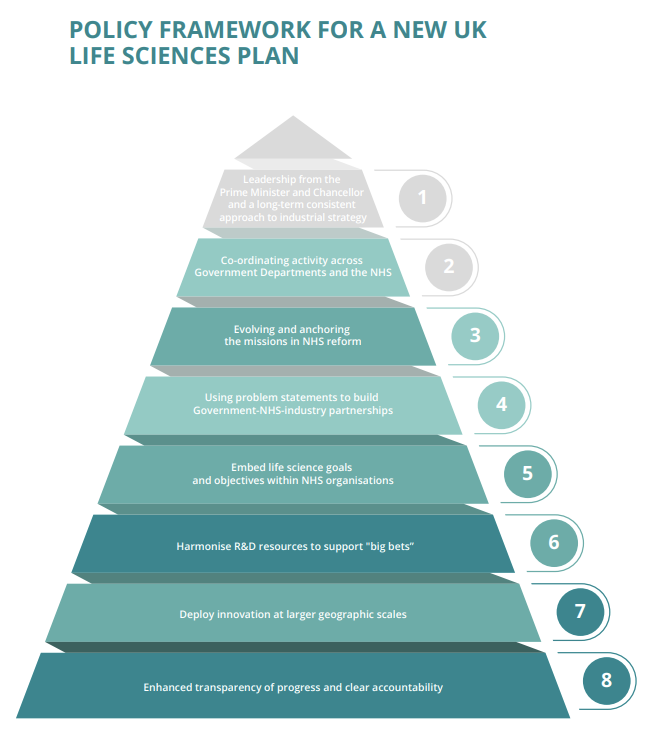
A new plan should seek to address this through adopting the following approach:
Promoting and maintaining a consistent long-term approach to an active
industrial strategy. The new Government, led by the Prime Minister and Chancellor, should use the creation of a new life sciences plan to set-out ambitions for building a life science ecosystem that delivers, and co-ordinates action, so it brings both economic growth and improved health outcomes for the UK.
Ensuring senior co-ordinated Government leadership on life sciences is
reflected across Number 10, Treasury, Department of Health and Social Care, Department for Science, Innovation and Technology and NHS England with aligned objectives and priorities. To support this the profile and resources of the OLS should be boosted and the Life Sciences Council refreshed into an effective
co-ordinating body focused on the delivery of the plan, meeting more regularly,
commissioning and undertaking deep-dives on specific policy challenges to
unblock barriers and communicating publicly on progress and actions taken.
Evolving and anchoring the life science missions. The missions from the Life Sciences Vision should evolve to align with the forthcoming NHS ten year plan and the anticipated focus on prevention, early diagnosis and innovative treatment. Update the missions to include action on multi-morbidities.
Using problem statements to build mission partnerships and find solutions.
The Government should work with the healthcare system to create problem
statements that each mission needs to address (e.g. earlier cancer diagnosis).
Use this approach to then (a) galvanise Government-NHS-industry partnerships;
and (b) commission rapid policy reviews through expert ‘task and finish groups’
to help quickly identify and overcome barriers to progress.
Improving the co-ordination of delivery between Government and the NHS.
The Government should use the problem statements of the evolved missions to help embed life sciences and innovation in NHS service planning and delivery. Appoint a new Life Sciences Director, with requisite experience, to the NHS England Board with accountability for progress. Embed progress targets and mission goals – including those relating to economic growth – in relevant performance management frameworks such as the Mandate and the ICB Oversight Framework.
Harmonising resources. Set longer term R&D budgets for life sciences and
innovation at the Spending Review to provide greater certainty on chosen
priorities. Make fewer, bigger R&D bets, invest in core system fundamentals, and
harmonise and simplify initiatives (such as on health data). Ensure regulators and
bodies involved in the life science ecosystem are suitably resourced to support
the aims of a healthier and wealthier population as set out within the health and
economic missions.
Deploying innovation at scale. Utilise the relicensing of AHSNs, into Health
Innovation Networks (HINs) to reset expectations on the deployment of innovation
within the NHS. Use the evolved missions and the new networks to identify larger
geographic footprints to deploy mission based interventions at greater scale. To
deliver on this HINs will need new capacity and a clear remit for driving forward
innovation at scale within the NHS.
Enhancing transparency and accountability. Through reviewing and refreshing
the Life Sciences Competitiveness Indicators to ensure they are up to date, enable
effective international comparisons and line-up with the new life sciences plan’s
priorities. Develop a balanced set of metrics across the priorities of the plan
including a focus on levels of spend relating to new medicines and their uptake
within the NHS. Set clear targets for improvement across different domains and
commit to publish an annual report in Parliament on progress in delivering the
new plan and an online dashboard tracking performance. Where performance is
behind set targets, commit to publish clear proposals for recovery, with associated
transparent timelines.
The UK faces strong competition from around the world in building and attracting
investment into its life sciences sector.
Getting this new plan right will see the jewel in the crown sparkle for a lot longer.
This report is sponsored by Novartis Pharmaceuticals UK Ltd and has been authored by Future Health. The views and conclusions in the report remain those of Future Health and should be attributed as such. Future Health takes full responsibility for the report and associated publications.