The power of connection: Strengthening health policy responses to cardiovascular, renal and metabolic diseases

Executive summary
Great progress has been made over the last few decades in the management and treatment of major diseases including cancer and cardiovascular disease (CVD). However the burden and impact of these noncommunicable diseases (NCDs) is still rising quickly.
Populations are ageing and more people are now living with more than one condition. This is placing strains on healthcare systems that are primarily designed around disease specific pathways and approaches to care. It also comes with a growing and broader economic cost at a time when many countries are facing financial challenges.
Across the world countries have collaborated and established through the Sustainable Development Goals ambitions for change. Many countries have initiated their own actions to reduce the impact of NCDs.
However despite such efforts progress to date is off track towards such goals and ambitions. Analysis for this research finds that 4 in 5 countries are set to miss the target of reducing premature mortality from major diseases by 2030. Faster action is now needed.
This paper argues that one of the reasons why greater progress has not yet been made is that healthcare policies to tackle major NCDs remain disconnected. It highlights the need for addressing this by identifying particular disease clusters of interconnecting conditions where the impact is highest and then building policies that are more reflective of these clusters.
One of the major clusters that policymakers should prioritise in this approach is tackling cardiovascular, renal and metabolic (CRM) conditions. These are an interconnected set of conditions that contribute to 20 million deaths annually and place a growing burden on healthcare systems and societies.1
Cardiovascular disease (CVD) is the world’s biggest killer today and is set to remain so in 2050. One of the reasons for this is the rising numbers affected by interconnected CRM conditions including liver and kidney diseases – which are driving increases in the rates of CVDs. Liver diseases are associated with a higher risk of cardiovascular events and most patients with progressive Chronic Kidney Disease (CKD) die before reaching kidney failure, because of the high death rate attributable to CVD.2 3
Tackling this health challenge, requires an approach that addresses the risk factors and related conditions in a co-ordinated and interconnected way across obesity, diabetes, liver disease and CKD.
The paper identifies three levels of opportunity for delivering more interconnected policies for CRM conditions across national health plans, CVD prevention plans and in updating relevant clinical guidelines and health service models.
Whilst there is some evidence of countries looking to implement more interconnected policies to improve outcomes for CRM, the research shows that efforts to date have often been focused on more narrow forms of interconnectedness – for example between two conditions (e.g. diabetes and CVD) or a single risk factor (e.g. obesity and CVD), rather than a more fully and genuinely interconnected model.
Delivering this more interconnected model to policy development is highly complex and challenging. Health systems and their policies and pathways are primarily designed around particular conditions, specialisms and sub-specialisms.
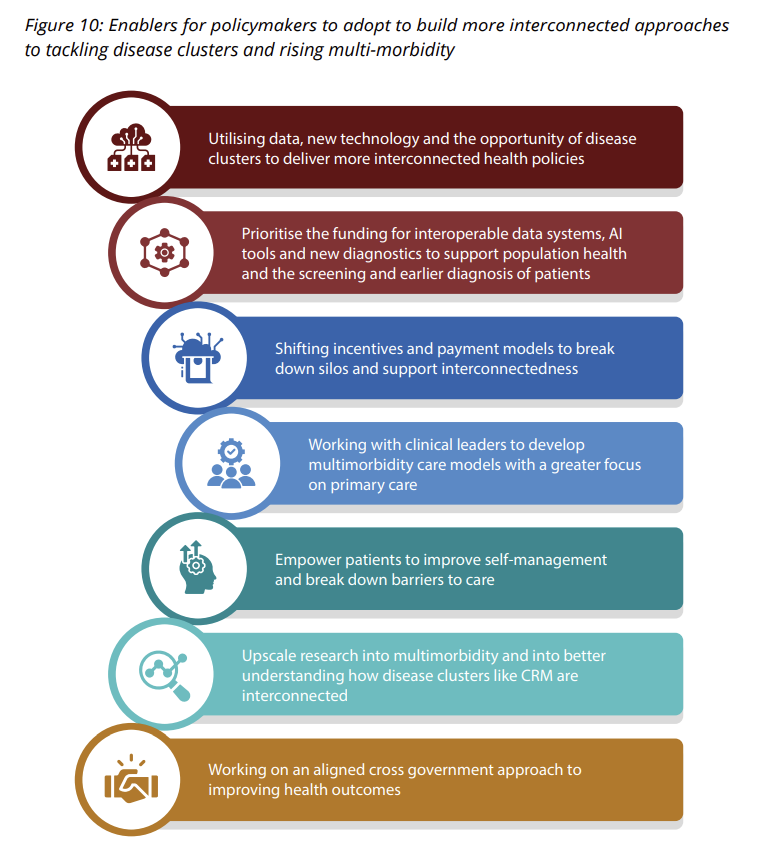
To move to this more interconnected model of policy making will require adopting a set of ‘enablers for change’. The research identifies seven enablers to deliver more interconnected policies:
- Utilising data and new technology to identify priority disease clusters such as CRM
- Invest in new data systems, AI tools and new diagnostics to support improved
population health and the earlier detection and diagnosis of patients with CRM
conditions through screening - Shift incentives and payment models to support interconnectedness around the
needs of CRM patients - Partnership with clinical leaders to develop multimorbidity care models with a
greater focus on primary care management and joined-up care for patients with
CRM conditions - Empower patients with CRM conditions to improve self-management and break
down barriers to care - Upscale research into multimorbidity and into better understanding how
disease clusters like CRM are interconnected - Work on an aligned cross government approach to improving health outcomes,
including for those with CRM conditions
By unlocking these seven enablers for change, new progress can be made in pursuing interconnected approaches to tackling CRM across the three policy opportunities of: national health plans, CVD prevention strategies and in the design of guidelines, pathways and models of care.
By prioritising such interconnected action on CRM accelerated progress can be made towards the goals of reducing the impact of NCDs, helping to improve patient outcomes, reduce pressures on health services and support wider economic benefits.
Summary recommendations
Conclusion
Health needs around the world are changing. Older populations, with rising rates of chronic disease and multi-morbidity are affecting people’s quality of life, increasing pressures on health systems and economic costs.
Whilst policymakers have taken action at both global and national level to seek to reduce the impact of NCDs, existing plans are struggling to meet the scale of the challenge.
This paper proposes an approach to tackling NCDs that focuses on building more interconnected health policies that prioritise particular disease clusters such as CRM; with an aim of making more rapid progress in improving health outcomes.
To deliver policymakers can update and revise national health plans, NCD plans aiming to prevent CVD and clinical guidelines and care models to make them more interconnected. But in order to do so effectively policymakers will need to address the seven enablers for change.
Change in healthcare systems is challenging but new data, technologies and diagnostics present opportunities to think, act and deliver in a more interconnected way and build a more patient centred future for all.
This independent report was commissioned and funded by Boehringer Ingelheim. Full editorial control rests with Future Health and Boehringer had no input into the final text.